Sunday, June 20, 2010

Bloggin' Be My Life - Meditations

Meditations on the Military Industrial Complex

Based on Readings from Mein Kampf


Two things occur to me at this point. The military industrial complex, what is it? And secondly, is peace a realistic possibility or is war inevitable?

Isn’t the notion that War is inevitable the whole premise of this book, Mein Kampf?
After World War I probably the strongest peace movement that the world had ever experienced took hold. The world was appalled by the tragedy of World War I and most people never wanted to see such a thing happen ever again. But the talk of peace bored the belligerent and enraged the militants like Adolf who saw peace only possible through dominance. It also threatened the livelihood of the wealthiest manufactures in the world, those who produced war goods and materials.
The Military Industrial Complex?

In the name of protection and self-defense, national manufacturers produce weapons that will counter any possible aggression. During times of conflict this type of production is stepped up to a point where it becomes the main industry of a nation, employing millions. What industry in terms of production could compete with the weapons industry? In what other industry do you manufacture something which is then immediately destroyed, and because of the circumstances, instantly re-demanded, and at whatever the price?

People are employed by the weapons industry. The products that they produce are then blown up; money is then taken from the paychecks of the workers within this industry (taxes), and reinvested in more bombs to be blown up once again. Money is also contributed to this industry from all other, even non-related industries, liberally and freely for the cause of the survival of the nation.

Then the war stops. What do we do? We close down these industries and return to consumer production? But millions of workers are then displaced. No consumer industry can compete with an industry, in terms of production, that blows up its product almost as soon as it is manufactured. Unemployment is the result. Consumer goods are also subject to supply and demand and their price fluctuates. Wages and profits in consumer industries cannot compete with an industry whose wages and profits are without any natural controls. The bombs must be manufactured and paid for. This is necessity. The only restraint on profits is the conscience and patriotism of the industrialist manufacturer.

The restraint on wages is somewhat better. The supply and demand of workers comes into play, along with the pleas to conscience and patriotism. But wages can always be higher in this type industry because profits are almost without controls. The only control is the government, and the possibility of it exhausting the finances of the people of the nation. But if the finances of the Nation are being supplied by the taxes being collected on the wages and profits of the Armament industry there is no end to the cycle of prosperity except for the horrible outbreak of ... PEACE!
This was Adolf’s biggest fear, and eventually one of Adolf’s biggest backers was Krupp Industries. But, if the government gets its money from the taxpayers and the taxpayers are getting their money from industries that are getting their money from the government, where does the government get all of this money?

The bombs are not sold to anyone, they are simply exploded. The money that is being supplied in this cycle is actually pieces of printed paper that the government itself prints in the form of bonds that its sells to other citizens and now foreigners. It really has no backing. It cannot be redeemed for gold or silver or precious metal or jewels but only more and other varied pieces of paper.

But, wait a minute, actually it can be. With money you can buy gold and silver and jewels at the free market place, at a price in paper determined by the faith shown in that paper on an international money exchange. If it is not a reserve of gold and silver that backs up the pieces of paper that a government prints, what determines the quantity of paper money that a government can print? This sounds like the old nursery rhyme Peter Piper picked a peck of pickled peppers, to me. But in any case, we have governments all over the world printing paper money, with different value equivalents that are accepted by other countries on the basis of what? Faith? Hope? ... What?

A foreign country will accept our currency because even if other countries refuse to accept it as money, they can then use our government’s printed money to buy our country; its land, its capital goods, its industries. So, in this case, what is really backing up a government’s printed paper is the Country itself – its physical existence. But then every country is actually in jeopardy of loosing its very soil to a more acceptable foreign currency, and possibly a more powerful, or should I say wealthy, foreign government – without anyone firing a shot.

Can a country that can be bought and sold to foreign investors really maintain its nationhood?

Well, a country could pass a law stating that with its money a non-citizen cannot buy the actual soil and buildings of their country. They can not purchase real property. They can only buy goods and services from that country. But if a country does this would it not cause the value of its money to be decreased in international faith because now the spendability of their money, its real value, has been limited?
So then by printing money with no backing, countries are actually putting their homeland up for sale. But if you buy that homeland what can you do with it? You then have to control the government of that country. If the government is rooted in a democracy or has a direct controlling linkage to its citizenry, then controlling its government becomes more difficult. But if the government is a dictatorship, or a powerful oligarchy, then you could choose a more direct route. Rather than trying to buy up a country lot by lot, acre by acre, you simply have to buy off the man or group who control the government, and of course its military. As for buying up a foreign country, or even buying up its government you must then always withstand the risk of internal revolution. If you had this power why would you want to own a foreign country - a country that can not be bound to you by race, nationhood or patriotism? You would probably only want to own this country surreptitiously, for the purpose of some sort of strategic gain against and enemy or for the extraction of some sort of needed or necessary commodity, or to repopulate it and expand your own nationhood.

So what have we come to with regards to the value of printed money?

Governments print money. The real value of this printed money depends on its foreign and domestic acceptance. Its foreign and domestic acceptance depends on its power to buy goods and services and real property throughout the world and within the country of its origin. It also depends on the power and ability of the printing government to control its population against internal revolution, and external aggression. So the value of a Country’s money also is dependent upon the stability of its government. The stability of its government is then linked to its internal popular support among its citizens, and its internal and external security forces. So can we then conclude that a powerful military and police force is essential to a stable economy, and that the strength of your country’s money may be involved in the strength and actual sovereignty of your individual nation?

The problem with gold and silver, as I see it, is that they limit expansion. Devaluation can only go so far before it looses all relevance – for example 1 million pieces of paper being worth one once of gold. With gold and silver how does a country expand its economy to meet the demands of increased population or expanding production? If capital is not expandable, businesses will come and go as grains of salt in a saturated solution and growth will be stagnant. Businesses simply compete for dollars in circulation. They do not create wealth. For an economy to be unlimited the money supply must be unlimited (elastic). There must be more and more money available and in a constant progressive supply.

At the end of World War I and at the time of Mein Kampf the German internal and external forces were in a shambles and its money was in the state of escalating inflation, or worthlessness. So, who or what was running Germany at the time of the rise of the Adolf revolution?

Winston Churchill expressed in his analysis of the times his lack of understanding of Adolf’s outrage over the reparations and demands of the treaty of Versailles. He stated that the United States at the time was loaning Germany more than enough money to pay all of its debts and reconstruct its country and its industries to boot while still demanding payment for its loans from its allies. At this time the United States had nearly all of the gold reserves in the world, and nearly every nation in the world was in debt to the United States due to loans made to them during the war. So it seems the United States had virtually all the marbles in the neighborhood. If it wanted to have anybody to play with, it had to give some marbles away in terms of more loans or forgive somebody’s debt.

Like in the game of monopoly the United States had everybody landing on its hotels and houses. No matter which way anybody moved they landed on U.S. controlled property and owed the U.S. money. So the U.S. had to redistribute its collected marbles, and forgive debts, or nobody could play the game anymore.

So they did. But my question is why did it give inordinate child support and welfare payments to the country that had given birth to World War I; the very country that it had just defeated in a bloody, horrible war – a war that had devastated most of Europe; a country against whom they themselves had declared war and sent their own children in the millions to die fighting against?

If we presume, for the sake of fantasy, and indulge in the oversimplistic notion of conspiracy, and say that World War I was in fact a trumped up war instigated and manufactured by the super-wealthy and the capitalist governments that they controlled, in response to the socialist worker revolutions that were taking place in all of the industrialized nations of the world, then a certain sensibleness does begin to reflect on this situation.

The international Capitalist manufacturers and bomb merchants were not mad at Germany. Germany was more or less simply a pawn in their game; the game being to disorganize and disarm the World Socialist Labor movement and divert their army through loyalty and patriotism to their individual nations by involving their countries in a War. But the propaganda against the Super-wealthy world capitalists had not been defeated by the efforts of World War I; in fact they had gained a certain amount of strength. The Russians Marxist or Communists (the Socialist Labor Movement), by the time of the publication of Mein Kampf, had murdered the Tzar, and taken over the government of one of the largest populations of the world. And the philosophy of their Government was basically the antithesis of the established order. The World peasant revolt had begun; a world Magna Carter was in the awakening; a national anti-industrialist Capitalist revolt had been consolidated and formed into a national government (Russia).

By the end of World War I the international Capitalist and bomb manufactures had backed the challengers to their thrown into a corner. The Enemy of the established order of wealth was the New State of Russia. Now if War produces wealth for us as industrialists, Capitalists and bomb merchants how do we turn the tide on the Russians? Why would we want to waste time beating up on the defeated Germans when the Russians had now emerged with the banner of anti-capitalist revolution?
We are now at war with Russia, but we have a problem. How do we turn the armies of our own countries against the anti-capitalist government of Russia when large sections of our own populations agree with their prophesies and speculations. In fact, American troops that were in Russia at the time of the end of World War I were ordered to attack the Russian revolutionary army, and the American leadership and soldiers refused. The soldiers said that their enemy was Germany, and Germany had surrendered, and now we want to go home and not get involved in a Russian civil war.
If we look at the situation in this light, it does make sense to rebuild Germany and re-establish its power. The Germans are fierce fighters and a natural enemy of the Russians. The Russians have taken a course to destroy the international kings or rulers of the world. We now have two enemies. An enemy of Socialist reactionaries within our own countries, supporting a movement against the kingdom of the wealthy super industrialists and war manufacturers, and the whole nation of Russia that is now under the control of those who seek to kill and destroy us, our power, our control, our wealth, and the system that has brought us to this favorable position.
Next, one must ask, who controls the government?

In a Capitalist society, I think that most will agree that the rich and powerful control the government for the most part. So then what is left to place restraints on the profits of the war time military manufactures? If the Military manufactures now become the biggest and most powerful employer and manufacturer in the nation, and thus the biggest influence within the government, then who is there to regulate the prices and controls on these bombs? Do we not have the foxes guarding the chicken coop?

I realize that this is an over-simplification, and that in a Democratic society we have the influences of the general voting public. We have the information supplied by a “free press.” And we have the complaints and competition coming from the legitimate consumer industries. But what happens when the rich and powerful Military industries buy up troublesome consumer industries, and the major newspapers, as was the accusation before and during World War I, which precipitated the world interest in Marxism and the rise in Socialism and radical Communism, not to mention the desertion of the Russians from the battlefields of Europe and the elimination of the Russian Tzarist traditional government? And what happens when armament industries during periods of reduced conflict form international alliances? As for example was the case with Krupp industries.

After World War II an attempt was made to dissolve Krupp (Nuremberg Trials) but it was determined that “its tentacles” were spread so far and wide throughout the world economy that it would be impossible to dissolve Krupp without disrupting, in some significant way the economy of the whole world. And, of course, the legal ramifications of trying to determine who owned what, was so far reaching as to be deemed impossible. Then again this might just have been a polite way of saying; if we investigate all the tentacles of Krupp we will expose too many of our own home businesses and other businesses in the free world that were also profiting from the death and destruction of their own countrymen. In other words to fully expose Krupp Industries would then expose the international nature of the “Merchants of Death” – those businesses, industrialists, bankers, and marketeers who profited from the death and destruction of War – any war.

Learning these factors to be at minimum, one of the causes leading to World War I, what steps have been taken to assure that these factors will or would not continue to be a problem in world affairs today? What controls do we have here in the United States over our own armament industry to assure that it is not an influence in promoting War for profit? What controls do we have over its potential international expansion, which could reduce its loyalty to the nation and lead it on a road to higher profits through precipitated conflict, rather than its traditional role and purpose as a national defense mechanism?

Who owns our present day armament industry and what share do they own in our national media? What assurances have we installed in our media enterprises to guarantee a freedom of our press?

What connection does our armament industry have with our national Military services, our Joint Chiefs of Staff, and Pentagon? Are these independent organizations working cooperatively, or are they an integrated unit?

Is our Armament industry a corporation whose shares are distributed in the international market place?

What controls do we have on international corporations that are involved in the security and defense of our nation?

We continue to have war after war after war, but have we set any system in place to learn the causes of these conflicts and suggest possible methods for their prevention in the future?

We have Military Academies that teach war, do we have any such Academies teaching or seeking the prevention of war? Certainly this cause is equal to the other and just as important to our national security.

Can we assume from looking at our institutions or the institutions of any of the nations of the world that they are seriously concerned with the prevention of War and the promotion of peace?

If peace is truly our goal shouldn’t a part of our enormous military budget be going to the purpose of preventing future conflicts and promoting peace? Or are we living presently in a world that is virtually controlled by the descendants and promoters of the philosophy of the author of Mein Kampf?

Germany lost World War I, but its Armament industry was not defeated, nor were the Armament industries of the rest of the world. The industry continued to prosper worldwide after the First World War. The movement towards peace suffered a humiliating defeat with the return of hostilities of the Second World War. The philosophy of peace and its defeat worldwide is pretty much captured in one word . . . “Munich.” Munich put an end to the “stupidity” and naiveté of seeking peace in the eyes of the world.

Again Germany was defeated in World War II, but the Armament Industry emerged worldwide strong and prosperous.

With the emergence of the cold war and the advent of the Atomic bomb and the nuclear arms race it precipitated, the bombs and bullet manufactures have grown to be without question the biggest and securest industry in the world. But how can it continue to grow? What does it do with its inventory in periods of non-conflict? How does it keep manufacturing new and advanced products? How can it continue to grow and expand? How does it keep up its payroll and growing number of employees?
There is only one way. It must sell off or continue to explode its inventory.
Trade in weapons is now the biggest business in the world, and small seemingly controlled conflicts are a daily routine. We have a professional army and no spot on the globe is not within the concept of our national security. The U.S. has a military presence of one kind or another in over two thirds of the nations of the world (approx. 168 of 200 nations).

The Military Industrial Complex? Is this not the industry of which President Eisenhower warned us? Are we now in the horrible economic position of the continuing necessity to feed the beast? And feed our sons and daughters, like the virgins of old, to the all powerful, all consuming dragon or volcano god of War?

And is this not the exact situation Adolf found himself in, once in control of his Military Government? And if this is the case how can we escape the paranoia of the Munich Syndrome, and move from the inevitability of War into a prosperous and economically productive peace?

Can we turn peace into an industry that will pay the dividends of a war economy?
How can we make creation and not destruction the goal? How can we replace industries that feed on destruction with industries that feed on creativity?

What tools do we need to wage this battle on a worldwide basis? What knowledge must be uncovered? What philosophy is there to counter the philosophy of Mien Kampf? The philosophy of War has defeated the philosophy of Peace. Those who believe in peace must dig deeper. They must find an answer and it must have economic consequences. It must be profitable.

If ‘money’ is in reality simply a printable commodity of governments of the world, used and accepted to purchase labor in the consequence of producing weapons (among other things) whose sole purpose is to be blown up or destroyed, why couldn’t this cycle be expanded to anything? I mean, isn’t this the ultimate ‘boondoggle’?

Why as a nation couldn’t we employ people to work in factories designed by Rube Goldburg, making products with no purpose or function, other than employing people? This would certainly be better than employing people for the purposes of blowing up other people, and creating and promoting an industry founded on hate, paranoia, and hysteria.

Why couldn’t we produce medical goods and pharmaceutical goods to be sold to the countries of the world to cure and help their sick and diseased, or food products?
But you say people or countries that do not have food do not have the money to buy these products. So loan it to them, lend lease? This is how we financed Word War II. And how do they pay us back? They don’t. We eventually forgive their debts, just as we did after World War II with all of our allies.

And on another point it seems that even the most destitute countries in the world have or find the ability to procure weapons, bombs and all of the necessary means to destroy themselves and those around them. Where do they get this money?

Why couldn’t we sell construction equipment in the same way that we proliferate weapons?

Space seems like a wonderful, limitless area to dump money and promote work projects for the people of nations. Food production and techniques, medical research and pharmaceutical production, Space, Scientific research, literature, the arts, education these are all areas that could greatly be expanded for the purposes of employing the population and producing products that, like bombs, are consumed, used up, or destroyed in one way or another. Couldn’t we gradually establish these type industries and slowly fade out the need for the proliferation of war industries and economies?

How about a couple of modern day Pyramids? Let’s build a stairway to paradise, with a new step every day. We can get there at any price, because as with bombs and bullets the price doesn’t matter. What really matters is that we continue to destroy them as fast as we can produce them.

The biggest problem with creating boondoggles to replace the War Boondoggle is providing the workers of the society with sufficient reward, and purpose. Human beings for whatever reason must believe that whatever it is that they are doing should have a purpose. They must think that they are being personally successful and that their work is necessary.

One purpose could be in finding a new planet for the habitation of our swelling world population. Then maybe we could concentrate on repopulating other planets of the Universe as opposed to de-populating this one.

Let the competitive instincts of the human beast soar in discovery, survival without cannibalism and self-destruction, in creation in the sciences and the arts. Certainly all the buildings of the outdated, inefficient cities of the world could be destroyed peacefully and reconstructed with architecture and design for the future. Let us feed the creative beast within the human animal and seek to subdue the destructive one. Your purpose for going to work each day is to participate in a project that will expand the scope of human understanding and creativity and build a stairway to the stars for the future expansion and survival of the human species, and, of course, to get your paycheck to buy your groceries, and the expanding amenities and consumer goods of the day.

You will advance at your project because of your ability to promote and advance toward the project’s goal successfully and competitively. These projects could be initiated by the government, through government contract, through private enterprise competing for government contracts, or through purely personal endeavor encouraged financially by the sale to consumers of their marketable discoveries, as is the exact case with most everything manufactured or produced in today’s world.

Many people get upset by jobs that are created via tax dollars as opposed to jobs created by the private sector. But like it or not it makes very little difference economically speaking which sector creates the jobs. In the public sector we pay taxes to create those jobs and in the private sector we pay the profit tax. In all cases we pay more per job via the profit tax than we do via the Government tax. Both government and corporations suffer the same evils. Both are bureaucratic both spend excessively and both suffer from periodic and varying degrees of corruption. As consumers and workers we have very little control over the corruption and excesses of businesses and international corporations. As citizens we have the vote and the right to petition our legislators. Who do you think you have the better chance with your appeal to fair play … the government or some international corporation?

If this all sounds insane to you examine your present state of affairs and the affairs of this world and determine which of us is the truly insane

America on Strike

Book Review

By Richard E. Noble


This book is a survey of major Labor strikes in America. It begins in the colonial period with the Boot and Shoe Makers Journeymen’s Trial of 1806 and ends with the Traffic Controllers Strike of 1981 and the Oystermen’s Strike of 1985.
The Oystermen’s strike is unique to this volume. It is included because I was an oysterman and I participated in that strike. I knew that it was not recorded in any of the annals of history and would never be recorded unless I recorded it. So I did so to the best of my recollection.

I documented everything in this book to the best of my ability and I did extensive reading and research. I personally feel that the bibliography alone is worth the price of this book to anyone seriously interested in this subject.

I footnoted many specifics and listed after each chapter the general reading material most dominant in producing that chapter. It should go without saying that all my reading on this subject is not listed. There are many books that are relevant and have been an aid to me in understanding these issues but did not relate specifically so I did not list them.

The volume also includes a few brief biographies of some outstanding characters in the American labor movement and it concludes with what I have labeled as A Theory on the Evolution of Today’s Liberal Politics.

My theory is written as a brief historical overview of the events and the attitudes towards those events that have been the stimulus for today’s liberal philosophy in my opinion. This is a positive evaluation and not a negative evaluation. It is meant to be an explanation on how and why liberals have come to their conclusions and opinions. I feel that this “theory” is valuable to both readers from the left and the right. After reading it many younger readers on the left should have a greater understanding of the foundations of their opinions and beliefs. For those on the right, it should provide insight into their “enemies” – possibly revelation.

There have been tens of thousands of major labor strikes in the United States and an equal number of prominent labor activists and fighters. This book is a small sampling designed by this author to hopefully stimulate others into continuing research into this subject. The history of labor in America is a neglected area in our American narrative. It deserves considerably more attention.

Saturday, June 19, 2010

Review Eastpointer

The Eastpointer

Book Review

By Richard E. Noble


This book doesn’t owe me a nickel. I was paid to write all the stories in this book by a local newspaper in my adopted hometown of Eastpoint, Fl. I was also awarded a first place for humor from the Florida Press Association with regards to this column and these stories in 2007.

The publisher/editor of the paper wrote in his departure that my column the “Eastpointer” was the most popular and most read column in the paper.

I tried to make people laugh or at least smile at themselves ... or at me and my local friends.

I published this first volume because of the advice of a friend. He said that I should publish these stories over my protest that they were of a local nature and not of much interest to “outsiders.” My friend felt otherwise. I re-read my stories with a different perspective and agreed with my buddy. Most of the stories in this series have a universal quality that folks either from the big city or a small town can associate with. After all they are stories about living in a small town that are written by a guy from the big city. They are all “Americana” and should be fun entertainment for anybody.

The majority of the stories are witty or humorous and I would like to think may even contain small bits of wisdom here and there.

I would also like to emphasize that these are “stories” and not so much newspaper columns. Each story has a beginning, middle and end. They are not about the “news” they are about the town and its people.

This is a fun book about a “different” type community and the people who live there. I will be publishing a second volume in this series in the coming year (2011).

Friday, June 18, 2010

Noble Notes on Famous Folks - Book Review

Noble Notes on Famous Folks

Book Review

By Richard E. Noble


“Noble Notes on Famous Folks” was intended to be informative but yet entertaining – hopefully even humorous. I had great fun writing this book. I would like to do two or three more like it.

I was inspired to write a book in this style by stumbling onto a writer by the name of Willy Cuppy. Mr. Cuppy wrote a number of great books. His most famous is probably, The Decline and Fall of Practically Everybody.

Mr. Cuppy was an intellectual and a wit. I make no such claim but I did my best. My book might not be quit so witty and hardly as intellectual but I feel I did a very good job.

The book lays down the basic facts of the people it describes with usually some not so well known tidbits thrown in. Many of the famous characters described in these pages are quite funny with no additional elaboration. There have been some really strange famous people – Abelard, Francis Bacon, and Tycho Brahe to point out just a few.

There are some who have stories that most people just wouldn’t believe. For example: Archimedes, Alexander the Great, Walt Whitman, and even Charles Lindbergh. If you like history, you will love this book. If you don’t like history because it is too dull and often written boringly, you will love this book. If you would like to read something and maybe learn a little something at the same time, this book is for you. Try it. I really think you will like it.

Thursday, June 17, 2010

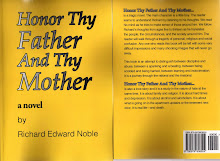
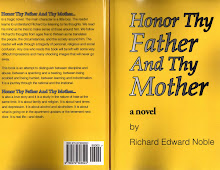
Honor Thy Farther and Thy Mother

Book Review

By Richard E. Noble


This is the most serious book that I have written. It is one of those cathartic books that all writers feel that they must write to square themselves with their consciences. Most writers have made a bargain with the god of truth. There are books that we all feel that we must write or our lives will have been lost in the small print.

I wasn’t going to publish this book because I felt it was too personal and because of the “Mommy Dearest or Daddy Dearest” implications. But then my wife read it. She read it and felt that it may be the best thing that I had ever written. She felt it to be objective and gave her insights into other lives that she had never gotten from her personal experiences or from anything else that she had ever read. She particularly liked the “style” of the book. When I told her that I had no intention of publishing it, she was upset. “You finally write a book that I think is great and you are not going to publish it? What is it with you?”

In any case, at her insistence, we began editing. We had some serious debates on this one but after all was said and done, we both feel that we came out with a very good novel.

The book is written in a style like nothing else I have written. It is stark and unembellished. This was one of those stories that told itself – I had to keep out of the way. Although it is written in the third person, it is the child who is actually writing this book. It is written from the inside out. You see the events from inside the child and as he grows, you grow with him.

It is a “heady” book with many different levels. You will recognize the different levels according to your experiences with life. Because of this fact, it can be read and enjoyed by a twelve year old or and eighty year old. Each will read and ponder a different tale. To one it might be the sad story of a little boy. To another it will be a Freudian mind bender. To yet another it may be a sociological triste.

As I said previously, it is a serious book. There are some chuckles as described in Richard’s first day at school or Grandma’s arrival at Christmas time.

But if I have done my job you will spend much of your reading time with this book lying open on your chest or in your lap as you reflect.

At the risk of being cliché, I wrote this book in the hope that it would be considered “thought provoking.”

I doubt if I will write anything this deep or emotionally involved ever again in my life. I have no desire to. Writing this novel was a strain and it took many years. I hope that those of you who are courageous enough to read this type of book will find it time well spent. It is not “Mary Poppins.”

Wednesday, June 16, 2010


A Little Something

Book Review

By Richard E. Noble


My first love in writing has always been poetry. I began writing poems as a teenager. This volume contains samples of my poems from the age of 18 to the age of 67.

Several of the poems also have prose introductions. I have loved that type presentation technique from the first time I saw it in a volume by one of my favorite poets, Robert Service.

My poems are the reflection of the different poets who I have read and loved over the years – Robert Service, Rudyard Kipling, Henry Wadsworth Longfellow, Robert Frost, Carl Sandburg, T. S. Elliot, Ralph Waldo Emerson, Emily Dickinson, Elisabeth Barrett Browning, Ogden Nash, John Milton, Robert Blake, Edgar Allen Poe and others.

I love poetry because of its simplicity. So many things can be said in a poem, and in a very short space, that are rarely spoken of elsewhere – at least not so eloquently.

This volume contains a balanced variety of many different types and styles of poetry that I have “played” with since I was a teenager. "Sunday on the Corner" and "The Call of the Dead" are a couple of my earliest poems. "Edith" and "Have You Come to Take Me Home" are examples of some of my later poems.

I have ballads, poems that rhyme and poems that don’t rhyme. I feel that I have poems in this volume that are so simple, "My Little Friend" and "But Do You Love Me" that even a five year old could find joy in them.

On the other hand there are poems like "A Child of Night," "Scarlet Letter," "Over and Over" and "Making Love" that might cause the intellectual to make note or the seasoned poetry lover to take pause. This is a great book of poetry with no age barrier. I am extremely proud of it.

Monday, June 14, 2010


A Baker’s Dozen

Book Review

By Richard E. Noble


I have been writing short stories since I was a teenager. This book is a sample packet of what I have been wasting my time on for all these years.
I have to laugh. Most of my old buddies – or the few that are still hanging out on this planet – have been aware of my reclusive writing habits forever. After publishing this volume, I heard from a few of them. They all complimented me on how much my writing has matured and improved. Interesting enough, when I asked them which stories they enjoyed the most, invariably they chose one of the stories that I had written when in my teens or twenties. That’s funny. There is a lesson there somewhere – but I’ll look for it some other time.
I’m not going to tell any of you which of my tales are from my “early” period or which are from my “mature” period. You will have to guess. But I can tell you one thing, if I thought the story was poor, I discarded it years ago. I have thrown away more stories than I’ve kept in my files. The same goes for my poetry.
I put together this volume with the intention of presenting to the reader a variety of what I do. As a result, the book has no theme other than all the stories were written by me. Some are what is termed “creative non-fiction,” others are totally contrived. Some are funny, others are not so funny. Some are third person, others are first person. Some are idealistic, others are realistic. There should be something in this volume for everybody. My personal opinion is that there isn’t a bad or poorly written story in the bunch.
I’m a traditionalist. I like stories with a beginning, middle and end. I don’t like babbling just to fill the page. I don’t write for the sake of writing, I write with the intention of saying something. Each of these stories says something and each in a different way. I hope you will give this book a try. Your investment will go to a “Noble” cause, I assure you. Thanks for listening.

Sunday, June 13, 2010

A Summer with Charlie

Book Review

By Richard E. Noble

“A Summer with Charlie” is my biggest seller to date. It is a simple, straight forward book and it can be read in one sitting. It is a great book for the summer while soaking up rays on the beach. It is written in the local vernacular and it is filled will local memorabilia. I wrote it for all my old buddies in an attempt to bring back some of the good old days, places and happenstances and to commemorate our mutual pal Charlie who was not as lucky as the rest of us. He is quite a memory. My intention was to make him “quite a memory” for you also.
It is a sad story and it is a funny story. It is about a childhood buddy. It’s about the “old gang” and “hanging out.” It’s about good times and bad times and they’re all happening at the same time. It is another of those stories that I felt obligated to write. It had been on my mind for decades. When I finally sat down to write it, it didn’t take me a week.
It is getting some attention back in my hometown of Lawrence, Massachusetts. I have been up there a couple of times talking about it. I’ve been on the local radio station several times and had a reading at the local library. It is in all the local libraries and has been added to the history center or section.
A area upscale magazine will be doing a spread on the story this coming July and August. I will revise and update this review after the spread has been printed. The magazine wants the “exclusive” I’ve been informed. So shush, don’t tell anybody.
I’ve been told they are going to print the entire first chapter of the book, plus a bio of me, with support pictures for the book and a review by a local journalist. I’m sure they will do a good job.
It is a tear-jerker. If it doesn’t make you cry, you weren’t paying attention.
It is basically a true story. I, of course, embellished here and there and used a little “poetic license” but it is, for the most part a true story. I hope you all like it.

Saturday, June 12, 2010

Hobo-ing America

Book Review

By Richard E. Noble


This was the most exciting adventure in our lives and despite all the conversation, very few people actually do what Carol and I did. We sold everything we owned, including Carol’s little MG Midget; bought a van and hit the road, Jack. We left our secure lives in 1976 and the adventure never stopped. I was managing restaurants and Carol was a reparatory therapist working the emergency room at a Miami hospital.

When our initial adventure capital ran out, we were reading the Grapes of Wrath by John Steinbeck. We were inspired. Why couldn’t we get crazy migrant/hobo type jobs and continue traveling across America? We did. And that is where this book begins – in a farm labor bureau employment office in California. We were signing up to go “top onions” with all the poor contract laborers and illegal immigrants. The interviewer thought we were nuts.

I subtitled this book “a workingman’s adventure.” That is not quite fair to Carol who also lived a “workingman’s” life. She didn’t sit back at the van baking cup cakes. She climbed 20 ft. ladders to pluck oranges from the top of thorny oranges trees; she tonged oysters from the bottom of Apalachicola Bay; she topped onions crawling around on her hands and knees in the desert-like sun of southern California. She did a “man’s” work, as they say.

We are both now well into our 60’s and as I review this book and our adventure, I must say I found a girl who was one in a million. Carol can gripe with God over what she was given but I certainly have no justified complaints on the girl he sent to me.

We had so much fun on this adventure that I felt compelled to write a book about it. Our adventure began in 1976 and ended in an ice cream parlor in Carrabelle Florida in the year 2000. That’s where the book ends but our adventure is still in progress.

Deciding to pack up and leave Fort Lauderdale and our steady, dependable jobs and lives to have a little adventure before we were too old to enjoy it, was truly a monumental decision. It changed our lives and it changed us … for the better.

When I compare this to other travel books and I have read them all – On the Road by Jack Kerouac or Charles Karualt, Mark Twain’s many travel books, the Dove, Walking Across America, Blue Highways, Travels with Charlie by John Steinbeck, Notes from a Small Island by Bill Bryson, I think Hobo-ing America stands out as somewhat unique. We worked our way around this country. We weren’t on a sabbatical or a scholarship. We weren’t getting a check from National Geographic. We worked and we worked hard doing jobs that the majority of Americans wouldn’t do on a dare.

There are only two other books that I think compare with Hobo-ing America in this regard, Two Years before the Mast by William Henry Dana and Pages from a Worker’s Life by William Z. Foster. Those two guys also put in some sweat.

This is a fun book. It is written as Mark Twain advised, without the author forgetting his sense of humor. Carol and I had great fun and met bunches of loveable and very interesting people. It was the experience of a lifetime for both Carol and I. We both hope you will buy a copy and enjoy reading it. Good luck on your adventure.

Monday, June 07, 2010

War and Economics

Part I

By Richard E. Noble


War is good for our national economy. It creates employment; encourages investment; builds new industries; promotes higher wages and raises values on the stock market.
I am convinced that the majority of Americans believe that the above is true - some have a conscious belief that it is true and others only a sub-conscious belief. But, all in all, most Americans believe, though it may be unfortunate - even sad - that war is good for business. It brings prosperity. Of course, you must be fighting the war in another country, but that has not been a problem.
Both the Democrats and the Republicans in the United States Government are pro-War.
The Democrats want to promote “moral” Wars - wars that the country can engage in for humanitarian purposes. “Fight for Right but not for Might”. The Republicans are not quite so conscientious. The two parties’ only disagreement seems to be in the choices and the methods and logistics - but both want war. The reason is because War is necessary to America’s economic well-being.
I have had people today tell me that even with our present government spending on these two foreign wars we are now engaged in, even with the looming deficits, the burgeoning National Debt, and the inevitable inflation that follows with it, they are still better off financially because of the increased value of their investments in the stock market and the rising interest rates on their CDs and bonds. They feel that their stock market and other investments are outperforming the debt and inflation that the war encourages. So economically war is a winner, not a loser.
Peace-nicks and pacifist for decades, maybe centuries, have tried to counter these arguments by presenting to the people all the negative moral, social, environmental, personal and world impacts of War. Everyone nods their head in agreement and says ... yes, yes - but it must be done.
World War I basically made the United States the richest country in the world. And World War II cured the Great Depression - the biggest economic disaster in modern history. During these conflicts the businessmen prospered, the industrialists and Bankers prospered, even the workers prospered.
The Vietnam War brought with it the greatest period of continuous increased economic growth yet to be seen in American History - with no tax increases.
Most Americans believe - though some might not say it openly - America needs war to feed its thriving Military Industrial Complex. Without the stability that is brought to this nation via spending and investment in the Military and it supporting Complex, America would go into an economic tailspin and precipitate a World Depression like never seen before in human history.
Instead of debating with this economically accepted principle and trying to prove that it is not true - let’s accept that it is true. Let’s sit down and figure how War is able to produce prosperity; and then with that knowledge under out belt, try to figure out how to use the methods employed in promoting and sustaining War (Cold or Hot) to the positive advantage of our nation - and residually for mankind.
How does War work; how does War make money?
After World War I we had a good many people who tried to expose War as evil, pernicious, and negative. They made a good run at it; they precipitated a number of investigations and caused a number of National and international scandals. You can check into the “Merchants of Death” investigations for more on this topic.
But this attempt to convince the world that war was bad or negative failed miserably. Those who promoted the idea were labeled cowards at best and, more often than not, traitors.
For a brief enlightenment on this matter you can check into the Nye Committee investigations on War profiteering; the DuPont Munitions Plant controversy; and the public lives of both Albert Einstein and Bertrand Russell.
Strangely enough it was Winston Churchill and Adolf Hitler who won the argument in favor of War. War does make strange bed-fellows.
Adolf Hitler was the advocate for the Glory of War. Adolf not only considered War to be a positive, but that it was an absolute necessity and the Will of Divine Providence - we seem to be having a revival of Adolf’s philosophy on War today around the world - both in Muslim and Christian countries.
Winston Churchill was also somewhat infatuated with the glory and character building nature of war. But he came more to his positive War position from the point of view of self-defense and cruel necessity. I would say that most of America supports the Winston Churchill position today. War may be terrible but it is necessary and all those who participate are heroes - all those who refuse are basically, if not cowards, severely misguided.
So it was not World War I that turned War into a positive economic policy. With no War the War suppliers and purveyors had to cut back, slow down or close up entirely.
After World War I the U.S went into an immediate recession or depression - employment fell, business investment fell, consumption fell but nevertheless, prices went up. Labor struck out demonstratively. In the year 1919 alone, 4,000,000 workers walked off their jobs. There were 3,630 strikes in the year 1919. The lack of a continuous War produced economic disaster. This has always been the case.
Then came the Great Depression. And the Great Depression led to a Great Economic Debate. This Great Economic Debate centered on the questions of how this collapse could have happened and how the economy could or should be revived.
Albert Einstein and others talked about over-production and the too rapid increase in technology. John Maynard Keynes talked about a mysterious disappearance or drying up of savings. Others commented on the sudden shortage of money in circulation and about the lack of consumption and incentive for business investment.
Contrary to popular knowledge Hubert Hoover doled millions of federal dollars out to the wealthy and the investment community in the form of tax breaks, incentives and outright gifts. But the business community wouldn’t spend it - at least not here in the United States. So down and down things went.
The poor, the unemployed, and the partially employed screamed for the government to do something. The wealthy and the business community said that economics was not a matter of government control. The country and the people of the United States would just have to tighten-up and endure until the “business cycle” once again started rolling in the right direction. It was just a matter of time and waiting it out. And beside a little time without a job would give all these striking workers something to contemplate.
In 1932 along came Franklin Roosevelt. His overall philosophy was basically rather simple. He would take tax dollars - money basically collected from the rich and the wealthy - and spend it on creating jobs for the unemployed, starving and homeless - the Robin Hood Principle.
Needless to say, the rich were not happy with this solution. They had all come about their money the “old fashioned way” - they had earned it - in a very competitive market place. They didn’t go out on strike to get it - they worked for it.
But with unemployment approaching 30% with another 20% only employed part-time and even those with jobs receiving pay cuts and threatened with the loss of their jobs - Roosevelt’s philosophy prevailed.
In the light of the recent developments taking place in Russia, Conservatives called this Roosevelt policy Bolshevist or Communist inspired.
The poor, the unemployed, the homeless didn’t really give much of a damn what they called it, as long as it meant food in their mouths and hope for the future.
Now this is the Great Debate - Did the Roosevelt, Robin Hood policy of Government spending - taking the money from the wealthy and giving it to the poor - work to bring back investment and prosperity or not?
Well, though I have read many interesting books arguing and analyzing this historical economic experiment, it seems to me that the consensus - certainly the consensus in the minds of the average citizen - is that this policy did not work. What solved the problems precipitated by the Great Depression was - World War II.
So, War is the answer and everybody knows it. It was not Government spending but War that returned America to prosperity.
So then - the truth is the majority of the people of America believe in the teachings of Winston Churchill and Adolf Hitler. In Adolf’s case some today still agreeing with his Solution to the Jewish problem and some not agreeing, but nevertheless, all accepting his basic premise with regards to the positive-ness of War in general.
At the end of World War II a new twist was added to this theory or proposition - War is the answer to continuing and sustained prosperity.
The problem was that the War had come to an end - again. That is one of the biggest problems with Hot War - they keep ending. Now what?
Well the answer to that question was pretty simple. Without a War the prosperity would die. It would be the same old story. It happened after every War. Business investment would decrease, soldiers would be idled - and looking for real jobs - women would be replaced from the workforce along with many men; wages would fall, consumption would decrease; business investment would be further cut and once again the vicious cycle of recession/depression would be on the rise. Not only that but we had Uncle Joe and the Russians to worry about. What do we do?
No amount of consumer goods could ever replace the investment and job promotion precipitated by War. As Mr. Grumman once said: It takes a lot of canoes to make up for one F-15. Even planned obsolescence and, pre-ordained product disintegration could not compete with the producing and immediate destruction of bombs, bullets, tanks, ships, and airplanes. In what other industry are products manufactured for the sole purpose of destroying? Only for War. And only with war is this type of production approved and supported by the overall population - after all it is the way that it must be.
In War every unacceptable business practice is tolerated - graft, corruption, profiteering, kick-backs, pay-offs, excessive inordinate costs, excess wages, faulty production techniques, black marketing in the war-torn countries; you name it and it is overlooked during a War. The business community loves War. No legitimate peace-time business can beat it for unchallenged, unadulterated PROFITS. It is the best business and business idea ever devised - save possibly Banking. [Banks are able to give IOUs to their depositors and collect “cash’ from their borrowers. If the depositors come rushing back for their money which the bank has loaned out, the government will sustain the banks with low or no interest loans. And even if the bank fails totally in its obligations via a series of bad loans, possibly to friends and relatives, the government will pick up the loss. There are not too many businesses like that in the world.
But, if we let the inevitable, post-war business cycle continue we will be setting ourselves up for another Pearl Harbor. Once again we will be unprepared - and the Russians will get us just like the Japs did. So, what do we do?
Basically what was decided was that we would keep the machinery and the investment in War in place - just as if the War had never ended. This was called “The Cold War”.
So now we had Hot Wars and Cold Wars. We would keep up this exorbitant investment and inevitable waste in over-production of War implements and goods stockpiled (if the war is Cold, unfortunately we have no place to blow these products up) by explaining to the taxpayer that it was necessary in order that we “be prepared”. But whether it is a Cold War or a Hot War we once again had the proper answer to the question of continuous prosperity ... War.
War is once again the answer.
The Cold War was a good solution but it was not the perfect solution.
The problem was that under the Roosevelt Robin Hood economic policy the rich taxpayer paid the greater portion of the expense for this solution to continuous economic prosperity. Roosevelt actually increased taxes on the wealthy to pay for the War. This is something that Lyndon Johnson, Richard Nixon, Ronald Reagan, and GW have chosen not to do. A better answer had to be devised to spread the burden of the peace through War policy via this Cold War economic enterprise.
The answer was Deficit Spending.
Of course this was also a part of the Roosevelt Robin Hood policy to help the poor during the Depression years. But what was necessary in the more prosperous post war era to satisfy the complaint of injustice by the rich was a redistribution of the costs. Instead of increasing the taxes to the rich and super wealthy - they would be cut. The resulting shortfall would be gradually compensated by borrowing - Deficit Spending.
But how does borrowing take the burden of payment off the backs of the rich?
Inflation spreads the total costs out over the entire population. It does this via the compensating effects of inflation.
All classes of people then pay proportionately. The wealthy and super-wealthy pay extra for their yachts, sailboats and racing horses; the poorer class pay extra for their bread and butter. The middle class pay extra for their cars and pickup trucks. And even the wino pays extra for his bottle of M-D 20/20. So everybody is happy and the idea that the rich should pay more because they benefit more is dissipated. Inflation is egalitarian and democratic.
In addition borrowing for the Deficit also provides the wealthy and the super-wealthy the opportunity to purchase the treasury bonds that the government has issued to borrow for its deficit spending. So instead of the rich having their incomes confiscated by the government via taxes, they actually get to invest their money and their dispensated tax rebates and gain a profit from the newly established debt. So with this system not only are the wealthy not taxed additionally to pay for the war, they are given the opportunity to invest and profit from the war. Of course this is much more appealing to the wealthy than the Roosevelt option.
So Deficit Spending and borrowing is a win-win situation for the super-wealthy. They collect on both ends and the middle.
Since the Republicans have learned about this method of paying for Deficit Spending they no longer have any fear of borrowing for anything and everything.
Now we have what is being called the reverse Robin Hood policy - the government takes from the poor and middle class while sending interest payments to the wealthy and the super-wealthy and providing tax cuts at the same time.
It a good deal for the rich and famous. They profit from their investments in the machinery of war; they profit in the secondary sale of the over-produced weapons - many of them are involved in arms merchandizing and arms sales; they profit on the interest payments on the national debt. And if there is an actual Hot War they profit from their ownership in the Military Industrial Complex; they profit from the international sales of the weapons of mass or minor destruction; they profit from the increased interest rates on treasury bonds and notes; many of them even profit from the inflation because of the higher interest rates and any lag that they can manufacture between the wages that they pay and the real inflation rate. As long as the general pubic can be convinced that inflation is not escalating and wages can be kept low or even decreased - they can downsize and they can take domestic factories abroad and simply shut down their pension and wage burdened domestic enterprises.
So now we have War, Hot or Cold, and we have everybody paying for the cost - rich and poor alike - a few participating in the gigantic profits; some profiting modestly; and most profiting somewhat.
War works. War is the answer. War is the way to build a strong economy and promote the general welfare.
War and Economics

Part II

By Richard E. Noble


If we accept all the positive economic attributes of War and we admit that War is economically favorable - Then the question is “how” does it work?
If we can figure out the techniques and the technicalities of “how” war works maybe we can then apply this knowledge to other industries.
If war is in fact a business - a business that works - then its principles should be applicable to other endeavors.
The most profitable sector of war is the production and manufacture of the tools of war.
Of course in ancient times men marched off to war with very little preparation or implements - sticks and stones and their bare hands were good enough. In those times it was not the production or manufacture of the implements of war that made war profitable. It was the plunder; the booty; the slaves, the pillaging along with the joys and pleasures of rape, torture and killing serving as residual spirit enhances. In those times the armies and the individuals actually profited from the spoils of war - like pirating or thievery.
In today’s world it seems that Wars are not fought for such fundamental principles. Pirating and thievery are rarely even mentioned - though rape and torture are still quite popular on either side of any encounter.
The individuals involved do not necessarily gain personally from their efforts. Many of the participants actually suffer irreparable damage - even death - with no reciprocating financial reward. The profits of war are still democratically distributed but different segments of the warring populations are rewarded differently.
The soldiers are usually some of lowest compensated. Soldiers are the least organized. They have no unions; they have very few rights and a multitude of duties. The bulk of them are traditionally garnered from the poorest ranks of the societies involved. They have been the least educated overall. They are typically the “blue collar” employees working in the factory of War.
Officers and Generals fare somewhat better. Some of the high ranking officers actually do quite well. All military are based on a class structure - the higher ranking traditionally coming from the wealthier more prosperous families. They are better organized and consequently fare much better in wages.
The real beneficiaries of war are not the consumers but the suppliers - the manufactures, the producers, the corporation heads, the CEOs, the stockholders and their employees. This has always been the case.
As we all know if you can keep your homeland uninvolved in the actual conflict of the War, and send your armies overseas to war in other lands, the war becomes substantially more profitable. Even when one takes into consideration the costs of exporting the war, the profits are still enhanced by conducting the war abroad. You do, of course, have the dead and maimed who must be transported back to their homeland but nevertheless you avoid the impact and the damage to the infrastructure that the war inflicts on the country of destination.
Although the soldiers carry the war to the enemy they are not a valuable asset in the profiting from war. Similar to the employees in a consumer factory they are an unfortunate but necessary expense. Their value is that they carry on their backs and in their arms the accouterments of the war. They wear or service or harness the equipment; they throw the hand grenades; they shoot the bullets; they drop the bombs; they fly the jets; they sail the ships; they guide the missiles etc., etc.; but just as with the employees in the conventional factory they are considered a cost of production. Their up-keep and maintenance are to be considered as an expense and not as a profit.
But the war produces products which are bought and sold. Who are the consumers of the products of war?
The host country receives the abundance of the factories of War but it does not buy them and in most cases does not pay any of the expenses or cost for their production. They receive all of the products of the war factories free of charge.
The soldiers are not consumers either. They are given their products to dispense also free of charge. So who buys and pays for all the expenses of war?
Governments pay for War. They purchase the products and they then consume them.
They consume them by donating them free of charge to foreign countries. These countries, of course, didn’t ask for these products, nor do they really have any need for them; but they get them nevertheless. It is also not a matter of consequence to what country these products are donated. One country will serve the purpose just about as well as another.
These countries do not usually receive these products in a usable state. They do not receive these products to use themselves, but rather have these products used on them.
Once these products have been used, in most cases, they no longer have any positive value.
So you might say that governments create these products for War while also creating the demand and the market for these products.
Of course governments contend that there is a demand for these products. They usually contend that the countries that receive these products have asked for them.
After a war is over the country who has received the bulk of these products always denies ever having asked for them.
But in any case, from the business perspective, if we delivered these products to planets in outer space the business cycle of profit and loss would be much the same.
In other words, in order to create this cycle of profitability governments really do not need a host country.
The idea of having a viable host country simply makes the war easier to sell to the domestic manufacturing entity or nation.
But if the consumers of War are governments then we are lead to ask; Where do they get the money to buy and pay for the War?
Most Americans would say that their Government gets its money from taxpayers. But this is not entirely true. If the only money that the U.S. government had access to was what it takes in from the taxpayers then at most points in its history it would not have had the money to manufacture any of its wars.
The difference between what the American taxpayers have paid the U.S. government and the money that the U.S. government has spent is actually calculated and kept in a log book.
This log book is called the National Debt. Unfortunately this does not provide an accurate record because all the unpaid expenditures from past deficit spending are recorded in aggregate.
But the question is if the government didn’t collect this money from the taxpayers, where did this money come from?
Most people would say that the government simply printed it up - created it via the treasury. In which case the logical question would be; If the government simply printed up the money why didn’t it print up enough money to cover any deficit?
The notion that the government prints up money is only partially true.
If they just went to the treasury and had money printed up - much as a counterfeiter would do in his garage or cellar - that would be bad; or good, depending on your point of view with regards to proper monetary policy. But what the government does, seems to me to be worse yet.
They go to the Treasury and print up lOUs that they sell to customers for an agreed percentage of interest in return for cash up front. Why do they do that? Only J. P. Morgan knows.
So not only as critics claim have they created more money (inflating the currency in circulation) but they have also created future debt payments.
Again, why do they do this?
I don’t know.
But even though this is interesting to think about, it takes us away from the fundamentals of our War Industry.
All that we need to know is that the consumers of war are the Governments. And the governments buy the war by taxing its citizens now and in the future via the debt borrowing.
So the consumers of the War are the citizens of the countries involved in promoting the War in question.
So then, what do the citizens of the war producing countries get for their dollars (or whatever) invested via their taxes in War?
They get support for their businesses; they get jobs and a prosperous economy. At least this is what most people think and this is what most Americans have come to understand.
So the government collects the taxes and cash from borrowing from the people. The government takes these taxes (money and borrowed cash) and invests it in the industries and products of war. The government uses some of this tax money to pay the soldiers while the industries producing the products for the war pay their employees and extract their management salaries and profits while also paying dividends to their shareholders.
Those that are not directly involved in the industries of war themselves benefit residually by supplying consumer goods and services to all of those employed and benefiting from the War industry. This is no different from the grocery store built outside the automobile factory or the textile mill or the gold mine or whatever. The Boom-town that lives by catering to needs of the gold miners.
So what is the fundamental economic cycle taking place here?
Well, we have several factors. We have people; we have governments; we have money; we have factories; we have products; we have producers; we have consumers; we have soldiers; we have employees; and we have an overall concept that we call War.
The taxpayers give their money to the governments; the governments give their money and the money they have borrowed on their bonds (that will be paid for in future increments by present and future taxpayers via inflation) to the factories and the industries; the industries pay their managers, their stockholders and their employees; the managers, stockholders, and soldiers (or families of) spend the money from their earning on non-war consumables.
But eventually the government spends all of its collected tax revenues plus the money it has borrowed. It then must collect more taxes and borrow more money. The governments get more taxes by taking a portion of the incomes gained from the war industries plus the residual benefiting consumer industries and continue to borrow as is necessary.
Now, since the government only extracts a portion from the wages of those in the society, unless the residual industries surrounding the War industry is greater proportionately than the War Industries themselves - the Government will inevitably run out of money. Because if we theorize that it pays for all of the products and salaries and costs of war; and if the war industry only manufactures for the war at hand - since its products return no revenue it can add no money to the original money invested.
Let’s start at the beginning here once again.
Let us imagine that the whole economy is based solely on the Industry of War. Its factories only manufacture the products and implements of war - all of which are given away in one way or another. The planes, the bombs, the bullets, the tanks etc. are all used in the War effort - nothing is sold.
The war is financed by taxpayers and by extending credit on the collected taxes from future taxpayers. The only increased revenue to the government comes from the taxes collected from the new jobs created by the War Industries and the stimulation generated in the residual economy. If War is the only source of this economy’s income - this society will not be able to sustain itself.
If the industries of war do not sell their products to someone other than the taxpayers or the War itself does not produce spoils - war conducted in this fashion will be unsustainable.
War for the sake of war; war that gains no outside spoil; wars that are solely sustained by the taxpayers will eventually bankrupt any nation.
But what if the war is financed by future taxpayer debt and alternative weapons sales?
Well, financing via future taxpayer debt is basically a Ponzi operation. The scam will be sustained until the debt reaches a point beyond which the economy and the earning population has expanded.
This would be comparable to reaching a point in your personal debt where you must borrow money each week to be able to meet the interest payments on your credit cards.
The only way this could be sustained is if your borrowing power is infinite.
Unfortunately War is not profitable. And it must follow that it is being sustained by the legitimate business world - or simply creating debt on future taxpayers. The only way that a war can pay for itself and be profitable is if the country manufacturing the weapons and instruments of war is not expending them itself but selling them to other countries who are bankrupting their national economies.
This is much like the drug business - if you’re a user you’re a loser.
In the United States of America we do both. We fight wars and we manufacture and sell the weapons of wars. Oftentimes we do both at the same time. In many instances while our government sends weapons and soldiers to a selected country at the taxpayers expense, our businesses and manufactures sell their wares not only to our government but to surrounding countries including the country being attacked - World War II being a prime example.
But the theoretical question remains: How is war profitable?
Making War is only profitable if booty is attained. If there is no booty the only way a nation involved in a war can profit is via employment - soldiers and workers participating in the war efforts receiving wages. This will increase revenue to a nation by way of new or additional income taxes; but the income taxes collected are only a portion of the tax dollars expended - even if the profits of the war industries are taxed also - rather than subsidized. We have the Law of Diminishing Returns setting in here. But if the people employed in the War Industries spend their money on homes, refrigerators and the like and this creates jobs and consequently additional tax revenue to compensate for the war expenditure then one could theorize a profitable situation.
Let’s say that taxpayers pay one third of their incomes in taxes to the Federal Government. If a residual industry is built around the War Industry at least three times the size of the War Industry in profits and employees - then the nation could theoretically break even. If the residual industry is greater than 3 to 1 then the nation could actually make a profit.
So, we must assume that this is the theory of the profitable Military Industrial State. This is how we merchandise and capitalize War. To use and old phrase this is how we become established “Merchants of Death”.
Now that we have established the method for making War profitable, how can we use this method to establish other industries - possibly industries that do not involve Death and Destruction? Let’s review the business of war.
Governments “create” money through debt and establish additional revenues via taxation. The money created through debt and taxation is invested in the production of war. The majority of the products produced for war are destroyed via the war - and are given away for free. The government gets it “profits” from the war by taxing the new war industries and their employees and managers. But this alone would not give a return to compensate for the initial investment necessary to produce a war. There must be secondary sources of revenue to compensate for the enormous investments necessary to conduct war.
One compensating source of revenue is the sale of weapons and explosives or whatever to “observer” countries or third parties who watch the war taking place and realize that they must prepare themselves for the inevitable war that may strike them at any time.
Another source of return for investments is money gained through additional borrowing - this, of course is an eventual loser but it keeps the ball rolling and like all Ponzi scams it could go on forever as long as people “keep the faith”.
Probably the major source of war revenue comes with the cleanup and exploitation (spoils) after the host country is devastated. Of course if you lose the war or the aggressor nation gives up the war before it is brought to a conclusion - all of these potential profits go down the drain. But even this operation is a “catch-22” because there is no one capable of paying for the cleanup investment. Consequently the money for the clean up must be advanced once again via taxation, inflation or borrowing (debt).
The bottom line of this industry should be becoming obvious. The only way to continue to profit from war is to promote another war. As with all Ponzi scams new blood must be continuously brought into the equation. This would be the same for any business idea that is based on investment without sales. If you have no product to sell - or you blow it up or throw it away - you have eliminated the main source of revenue for any business adventure. Even if the business is service orientated - some one must “buy” the service.
[This has completed part II of War and Economics. Part III will be my next entry.]
War and Economics Part III

Conclusion – Utopia Revisited

By Richard E. Noble


We have established in War and Economics I and II that War as business can not be profitable unless the residual businesses and the secondary revenue sources are able to bring in returns greater than the initial and subsequent investments. In other words the government’s spending on producing a War must be out-distanced by the taxes collected, plus the expanding residual industries created, plus the excess sales of superfluous or outdated weapons produced by the War Industries and manufactures. If all this truly happens, as it seems to be happening and as most Americans consciously or subconsciously believe - then War is in fact profitable. And just to repeat for clarity’s sake - War is basically a Government business which manufactures a product that is given away for free or actually used to destroy other things.
If, in fact, this is the case then we see why governments promote war and we substantiate the basic notion brought forward in the beginning of this thesis - “War is a profitable and good business practice.”
War begins with government spending or investment. Government investment leads to profit and employment. Profits and employment lead to consumption in residual industries. If tax returns from the War Industries amount to 1/3 of initial government outlay and tax return from residual industries return the other 2/3 - then we have a government or taxpayer based industry that is paying for itself.
If returns from residual industries (some of which have real products to produce) are greater than 2/3 of original taxpayer outlay and borrowed money to create the industry then we have a profit making industry without even selling or using the products produced by the Industry or collecting booty from a war.
Is this really possible? Can an industry be created where an actual product is not necessary? Where no capital goods are necessary? Well, it seems to be the case. War it does seem is exactly that type of industry.
What we are suggesting here is that all we need to do is expend taxpayer’s dollars (or even borrowed dollars - or better yet un-borrowed, debt free, created dollars) so that they are redistributed to a portion of the public in the form of wages and profits which are then spent for real products that then start a chain economic reaction of societal sustaining residual industries - with the original tax investment returned to the taxpayers to fund future investment? We have thus created perpetual economic motion.
If we can sell the products from our War Industry we can further increase the profits from our Tax funded business, but this would be gravy - not necessity. The products can be sold or they can be thrown away - or blown up or exploded - or buried in a land fill or whatever.
If what has been established in the above is true - war is in fact a profitable business which has cured depressions, recessions and monetary catastrophes of any kind and serves as a viable policy for the sustenance of a nation - then how could we apply the principles learned above to benefit our nation in a more positive way - possibly eliminating all the death and destruction?
Well, if you have understood and accepted the above formula it should be quite obvious that if war can work as a profitable business venture - anything can work. This is all pure Keynesian economics. In other words; we the people or the government get investment capital via borrowing, deficit spending and general taxation (or just employing a free monetary printing press). We invest that money in any enterprise that creates jobs. The jobs produce a product - the majority of which is thrown away, given away or destroyed. If any of this product is sold to anybody at any cost - that’s gravy. Our real profits come from the taxes collected on the new jobs created and on the profits of the new businesses and corporations along with the residual businesses established as a result of the prosperity created by our “seed” industry.
So for example, if we wanted to replace the Military Industrial Complex with the Health Care and Drug Industrial Complex, it would be simple. We start “factories” with our government seed revenues that produce drugs that cure diseases. As with bombs and bullets we don’t sell these products; we give them away. We hire researchers to find new products and we set our goal to cure every disease known to mankind. We hire additional people to go around the world curing people with these drugs. Or we can be “Capitalistic” and loan the money to the sick people so that they can buy these drugs from our company. When they become well we employ them in our industry or a residual industry of their own creation (free enterprise) and then they pay us back with interest or simply by creating more prosperity from which we all gain.
Now we have money coming in from the income taxes on the employees and the profits of the employing company.
The increased spending from the people with the good jobs in this industry promotes residual enterprises and more jobs. These businesses and jobs are also taxed and now we have more “cash flow”. As with arms, we sell our drugs to countries who can afford to pay for them – wherever and whenever we can. Through our research we make new and better drugs but then we sell the old technology to lesser developed countries. They will be more than happy to buy our old drug technologies - even if there are better products available, just as they have eagerly bought our old guns and bombs.
This whole scenario is exactly the same as our war machine but instead of destruction we bring Health. We have no cleanup program but instead we have an absence of sick and diseased people - who will work to produce other products that will serve to increase the World Gross International Product.
All our other industries - banks and whatever - will continue to work in their traditional ways - nothing will change. We will still have profits, salaries, wages, investments, invention, stocks and bonds, entrepreneurship and Capitalism. We will simply have constructive Capitalism instead of destructive Capitalism.
Different countries can pick different humanitarian industries to promote and they can develop their own Industrial Complex - if anyone can think of an Industry that actually sells a useful product so much the better.
We will all, of course, still be required to have our militaries but they can be geared down due to the obvious “peace divided’ that will result from an economic system that is clearly designed to do good and promote prosperity and health and happiness for all.
Almost any “business” that we could invent would be better than War. The products of our War industry are all blown up and destroyed and they are used to destroy other things. If we substitute producing an actual product - like health care drugs - we eventually sell them - possibly at a profit - instead of just giving them away. They develop in spin off industries and other residual business that involve building things instead of blowing things up. This creates rents, loans, interest payments salaries and whatnot. The world’s populations are employed, taxes are collected and this utopian business Complex becomes self perpetuating.
This whole concept is created on the idea of concocting a business without a true viable product - as the business of War does. The “product” of war is destruction; the product of our new industry will be creation - creation of anything positive.
If we accept that war works in the way that I have described it, then this business based on manufactured creation - as opposed to manufactured destruction - should work even better.
But if this whole scenario is false and War is nothing more than a sophisticated Ponzi scam that can only be sustained by another war and which will then only come to an end with the eventual destruction of all nations and their populations - then my Ponzi scam will also end accordingly but with positive as opposed to negative results.
The difference is that my economic Pozi scam, based on the “creation” of a better world, will only end after the whole world and everyone in it has been cured of all disease and benefited from every kind of knowledge; and every nation in the world has improved the living conditions of all of its population to the point where nothing better can be created or conceived.
If this be Ponzi, then so be it!

Bloggin' Be My Life - Private Property

Private Property

My zone, your zone, our zone and the ozone.

by Richard E. Noble


We hold sacred the Right to Private Property here in the United States. But this Right has not been without controversy. This notion once included the right to buy and sell other human beings and their children. It was also used by industrialist and Robber Barons alike to shoot their disgruntled workers and to deny them the right to organize and to bargain collectively for better working conditions and higher wages.
At one point in our history it applied to women and children. A man once owned his wife and children.

This Right to Private Property has also conflicted with the State and the Federal Government – Public Domain, Eminent Domain, National and State parks, National and State forests – roads, highways, interstate, damns, reservoirs etc.
On the international level, Private Ownership has been the divisive issue of the last two centuries. We define our current political systems by it:

Capitalism = Democracy + Private ownership
Socialism = Democracy + Public Ownership
Fascism = Dictatorship + Private Ownership
Communism = Dictatorship + Public Ownership

Conflicts with regards to public and private ownership are all around us today because of zoning laws and building codes and, of course, taxes. I’ve often wondered at what dollar amount a property tax turns into a rent. And considering the above definitions, when and if a property tax becomes so large that it is considered a rent; does Capitalism then evolve into Socialism? But even more interesting than that is the question of the basis and foundation of Private Property.

Private Property is based on a principle that, I think, no American would accept as fair, just, or even reasonable today.

Property has always been gained, from the beginnings of mankind’s times, through power, force and military might. The borders of countries have, for the most part, always been determined by conquests, invasions and war. Kings and power lords conquered and doled out property to their favorites. If there were people living on the property, they went with it. If you owned the property, you owned the people who lived on it also.

In the establishment of the American Colonies, we had what were called Patroons. The Patroons owned vast estates that were given to them by charters or grants or purchased from the Crown or others or that they finagled by deceit or fraud. It wasn’t until 1839 in New York that this manorial system was seriously challenged by the tenants who lived on and farmed the land. The land barons were forced by the revolt of the people and the New York Legislature in 1846 to sell off their estates in small farms to the people who lived and worked them. Of course, they sold off these vast estates at exorbitant prices, but nevertheless the tradition of small, individual, property ownership was enhanced.

Then the big money moved to the city. It was here that men like John Jacob Astor and industrialists like William “Billy” Wood and Andrew Carnegie, Pullman and bankers, like J. P. Morgan and John D. Rockefeller Jr., turned the development of cities into their personal gold mines. Tenement housing, an apparent monetary triviality, turned into multi-million and billion dollar opportunities for their investment capital. While Astor, and those of his unscrupulous agents and middlemen, got richer and richer, they turned the tenement factory worker communities into death traps for the poor and hard working. Diseases like typhoid fever, tuberculosis, cholera and others spread rapidly throughout the tenement communities. But the millions of dollars rolled in over the bodies of the poor until once again, as the rural tenant farmers had exploded in 1839; rebellion rankled in the streets and the tenement neighborhoods of Brooklyn, New York, Philadelphia and Boston. The disgruntled and downtrodden, brought to the end of their faith in tolerance and acceptance, were finally motivated to risk their lives in the streets and back alleys. Somehow their protests were finally able to rouse the politicians, and laws began to evolve to protect the health and well being of the families living in these pits of American industrial revolutional squalor.

Astor and his super-wealthy friends then decided that it was time to give or dump the tenements onto the masses. The investment brokers would liquefy their assets. They sold their uncared for, unhealthy, vermin and rat invested, tenement disease incubators, before laws could be promoted requiring the landlords to spend some of their acquired millions to clean them up. It was a good business move. But once again, through a dark backdoor, the cause of individual ownership and private property was extended.

The prices of the tenements were high and exploitative, but somehow many hard working laboring families were able to become property owners – participants in the prized evolution of the propertied class.

Adolf Hitler dealt with the historical right to national territory and property rights – by way of Power and Might – extensively in his autobiography, Mein Kampf.

Adolf could not accept that a great nation, like his own, could be, cramped in such a tiny space in central Europe, while a much inferior nation like Russia had such a vast expanse of land to the west. He used the history of mankind to make his claim that the borders of any country are determined by the will of their peoples. Those with the will and the power, take; and those without the will and power are destroyed. To Adolf this was the fundamental principle of Civilization and an undeniable law of Nature – the survival of the fittest.

Russia and a good many other nations of the world disagreed. A catchy phrase of the period was – Might does not make Right. As far as I know, nobody wrote a book explaining why Might did not make Right but many people felt that the notion had merit – even if they didn’t know why. Adolf went ahead and tried to prove his point, but failed. At least he failed to prove that his people and his nation had the will and the power to establish their Might as Right. Whether or not Might actually does make Right still remains questionable, but, by no means, absolutely without foundation.

During a period called the Enlightenment, the world seemed to go through a sort of introspection and soul searching. Philosophers, social thinkers, economists, political reformers and the like all began to question the right of Private Property along with a good many other long established notions. William Godwin wrote a book, Enquiry Concerning Political Justice in 1793, and in the Colonies a controversial pamphleteer, Thomas Paine, wrote a piece that he entitled Agrarian Justice. Godwin questioned the whole idea of Private Property and Paine, accepting that Private Property was a basic injustice, went on to devise an accommodation for property-less individuals.

An economist, Richard Ricardo, challenged property owners and the negative influence of their rents on the economy and wrote a book, Principles of Political Economy, challenging their moral and economic right to do so. He threw his support behind the new moneyed industrialist, entrepreneur and business community – he was a stockbroker by trade – and against the old, established class of property owner. He fought against the protective Corn Laws that were making land owners wealthy, claiming that these laws only served to increase wages, raise prices and create what is now called inflation. Ricardo, unintentionally, plants the first seeds of the class warfare which followed in later generations.

John S. Mill in his Political Economy – accepting Paine’s notion of the injustice of the un-propertied – tried to devise another solution. Paine had suggested that a tax should be placed on the propertied and that at the age of maturity every man without property would receive a cash inheritance as compensation. Mill suggested that the state would buy back from individuals all property and from then on, property would be rented or leased by the State. Henry George later expanded this idea into his Single Tax notion – but with no buy-back from the present property holders.

Then came Karl Marx and Frederick Engels who espoused an evolutionary theory of property that brought things back to Godwin. Their original idea was that private property would simply dissolve into an egalitarian utopia due to the inevitable collapse of Capitalism which would be prompted by the evolutionary destruction of monopolization. Lenin and others believed that this utopia was truly evolutional and inevitable, but evolution was just too slow. Lenin, and those who believed similarly, decided that the historical evolution of a classless, egalitarian economy needed the prodding of a benevolent dictator. True believing followers, like Joseph Stalin felt that benevolence was over-rated.

We no longer discuss the rights of the un-propertied or the moral justice of inheriting property, or people having too much property. We seem to have come to the notion that as long as a majority of individuals have the opportunity to work, save money, and buy their own piece of the planet – this is fair and just enough. The negative historical roots have all been put to the side, as beyond reclamation and practical justification.

Nevertheless, in recent years a return to introspection and moral and Agrarian Justice and soul searching has been revived. The exploitation and pollution of property and the planet has been suggested as morally unjust. There is now an argument between the property owner and the long term interests of random mankind.
Teddy Roosevelt had his preservation and set-aside notions which have given us our National Parks, forests and monuments. Today, we are now considering morally, environmentally and economically the use of an individual’s or developer’s property in relation to his neighbors – his community, his state, his country, the world – to future generations. It is the tree huggers against the libertarians.

Some go so far as to call this a revolution. The Green Revolution it is called. Peace and goodwill to man via clean water, clean air and socially correct balanced growth. The libertarians say these tree lovers are fanatics who care more about woodpeckers and brown-speckled, sap-sucking, bank climbing beetles than they do people. These people (tree huggers) hold Walt Disney as a god and fantasyland and Disney World in Orlando as a real possibility for the future of mankind and community development – these Libertarians say. And sometimes it is difficult to see if these Green revolutionaries are trying to make the world safer for people or fire ants.

On the other hand, if the libertarian has his way there may not be any more fire ants or people. We could revert back to cesspools of congested living, and rivers, lakes and oceans filled with green dyes, mercury, toxic chemicals, OIL, and non-edible, deformed, dying and disappearing sea creatures – not to mention, people (including Americans).


The “History of the Great American Fortunes” by Gustavus Myers was used in this essay – a very interesting Radical analysis of this accepted American Right.